Traditional Tàijíquán Concepts
Tàijíquán has many different branches, styles, and derivatives. When looking at the literature about the benefits of Tai Chi, it is difficult to know whether the results apply to the full range of variations. Traditional Tàijíquán concepts are gradually developed as a practitioner advances in their Tai Chi training. It is not clear which concept might be most beneficial to a beginner or if more advanced concepts might provide even greater benefits.
A few of these concepts are briefly presented here that may provide some insight to the mechanisms of how Tai Chi produces health benefits.
Tàijí (Yin and Yang)
Tàijí is not yin and yang existing as separate entities; rather, it is a single entity that binds yin and yang. Wang Zhongyue1
Yin and yang describe two opposite qualities in traditional Chinese philosophy. They are not actually a strict quality of something; both only convey that quality in relationship to its opposite. They complement each other and have the seed to transform into the other so that yin becomes yang and yang becomes yin.
In Tàijíquán, these concepts are utilized to help describe the sense of the movements and their intent. “For example, the back of your body is yin, and the front of the body is yang. The lower part of your body is yin, and the upper part is yang. When the palm faces your body, it is called a yin palm. When the palm faces away from your body, it is called a yang palm. The leg that is supporting the weight of your body is yin while one that is not is yang. Defense is yin and offense is yang, and so on.
Sōng (Relax/Loosen)
As one progresses in Tai Chi, they are often told to relax the body. Relax is not the best translation for the Chinese word Sōng (松) which is used in the TàijíquánClassics. Too often, it is interpreted as letting go of the muscle and collapsing like a rag.
An alternative translation is “loosen”, where it means “let free to act”. Sōng can be explained as freeing the joints. Initially, this is done by using one’s intent to minimize any muscle tension across the joints. The challenge is how to let go and maintain one’s posture. This requires utilizing the natural design of the human body for support against the forces of gravity while not tightening up the joints.
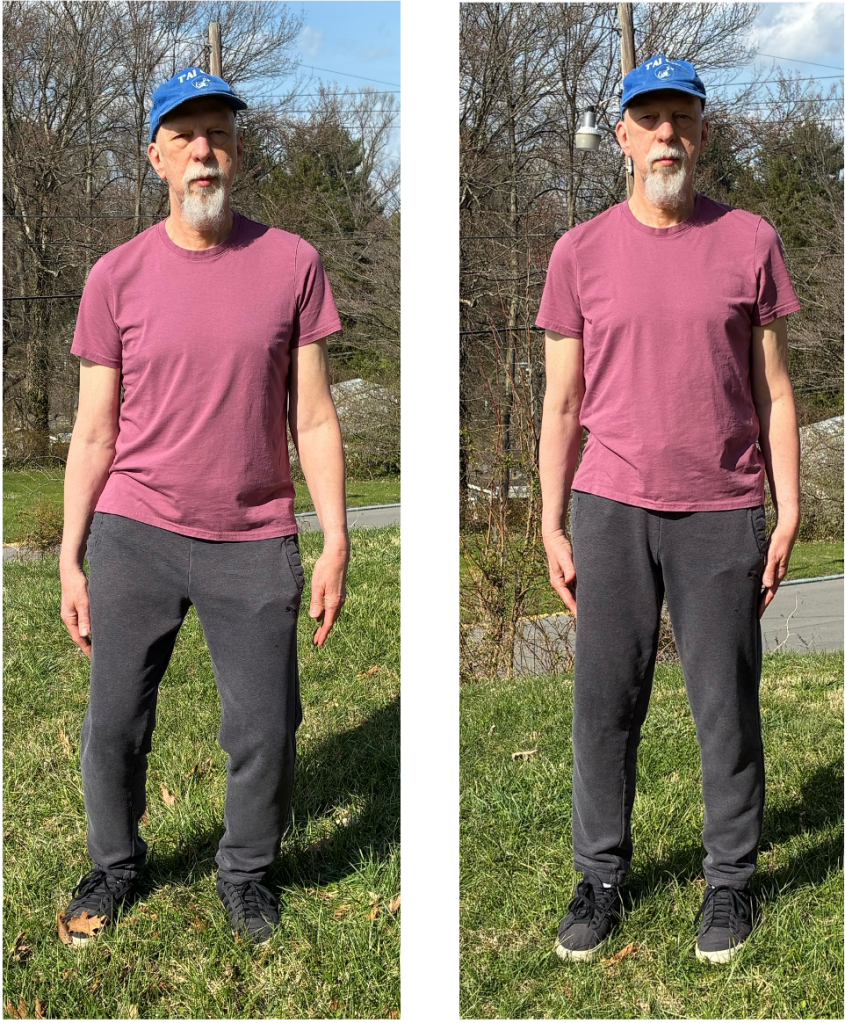
Figure1: On left is an untrained attempt at relaxing. While the picture on right incorporates the concept of song.
Peng/Bīng
(Ward off/ Expand)
The term Peng is also used for Bīng. They are used to both describe a type of “trained force” and a movement used to train it. This force expands with upward and forward internal power (not muscles). The attribute of this force is soft and expansive. The effort should be sensed as barely enough.
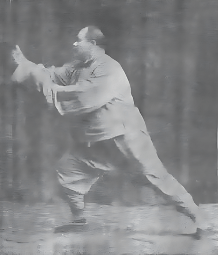
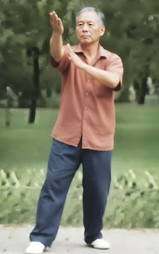
Figure 2: On left is Yang Chengfu in the ward off posture. While the picture on right is Wang Peisheng doing the Wù style version.
Shén and Yì
(Eyes and Mind)
These are higher level training that are found even in the basics. They are better translated as spirit and attention. The body responses differently when these qualities are utilized.
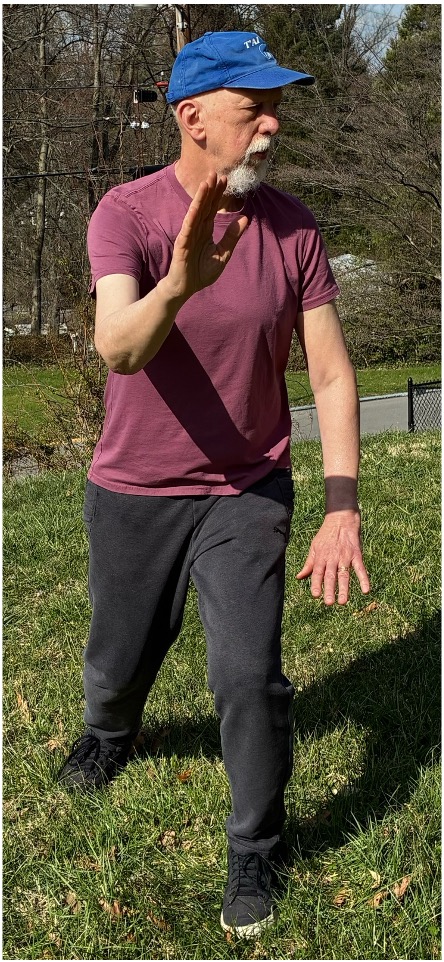
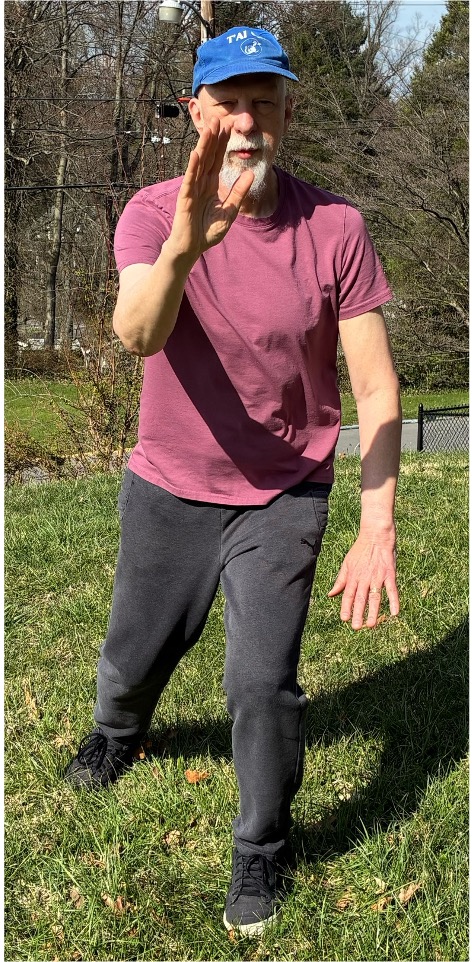
Figure 3: On left, the practitioner is not looking in the direction of the movement. The left hand is lower than intended and the body has more of a twist to the right. On right, the practitioner is doing a standard wù style brush knee form. His eyes are aligned with the movement.
External Integration
(Whole Body Movement)
In Tai Chi, it is said that when one part of the body moves, the whole body moves. When one part is still the whole body is still.
This concept is sometimes deepened by considering the three external integrations. In this training, the movements (and “stillness”) of the limbs are made with each major joint in the upper limb, ”feeling” connected to its corresponding joint in the lower opposite limb. As examples of these feelings, the left shoulder is connected to the right hip, the left elbow is connected to the right knee, and the left hand is connected to the right foot.
In practice, the connections are considered progressively. The focus can go left shoulder/right hip, then to left elbow/right knee, and finally left hand/right foot. It can proceed in the other direction or with the other pair of sides.
Previous: Simplified View of Fascia
Index: Science of Tai Chi Poster Info
References:
Figure 1: Photo by Rebecca Sturnfield
Figure 2: a) There are number or version of this photo with an early version in Yang Chengfu (1931). Methods of Applying Taiji Boxing. (太極拳使用法 楊澄甫). This version was on: https://thetaichinotebook.com/2022/07/10/how-do-i-raise-the-spirit-of-vitality/ b) This is a clip from a video at https://youtu.be/CFVREY1m1Q8 . Both images are Ai enhanced using Aienhancer.ai .
Figure 3: Photo by Rebecca Sturnfield
Note 1: Zhang, Y. (2016). The Taijiquan Classics. United States of America: Yin Cheng Gong Fa Association (www.ycgf.org).
© 2026 James F Sturnfield

