Computer Model of Tai Chi
Part of the issue in modeling is that the whole body is active in movement. The other issue is that it can’t be simplified to a traditional biomechanic model. This puts a large demand for the computations. The approach currently being developed is a hybrid of the various biomechanical models that have been proposed plus additional supplemental models as place holders for experiential qualities of tàijíquán and qi in the body.
The first models are focused on the elbows with simple connections to the rest of the body. The axial region is treated as a black box with the capability to transfer and supply forces to the appendicular region. The lower limbs are represented by the bones and the superficial fascia with simple models. The modeling is done in Mathematica utilizing its anatomy data.
These early models are looking at how sōngcan benefit dynamic balance compared to utilizing muscle to maintain support. This utilizes a study of the potential responsiveness of the body to changes in the center of gravity under different assumptions.
A comparison is made of changes between a scenario where muscles are utilized to create a balanced structure and one where an opening of the joints and connection of the fascia tissue is utilized. This modeling still needs validation with biomechanical measures and considerations about the assumptions being used.
There are several styles of Tàijíquán with various branches. Each has emphasis that exhibit distinct differences in the movements and possibly how traditional concepts are applied. The movements of the Wù style of Wang Peisheng will be utilized because of the specific alignments used in his training methods. Regardless, the models can provide insight into Tai Chi in general.
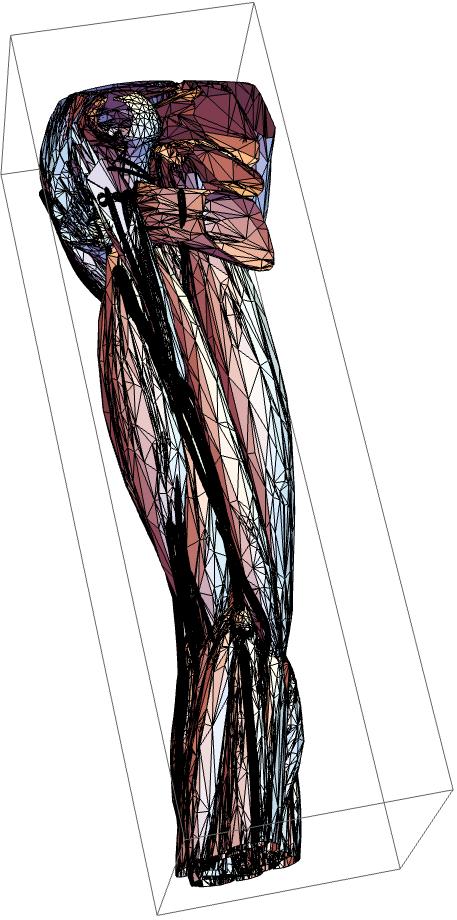
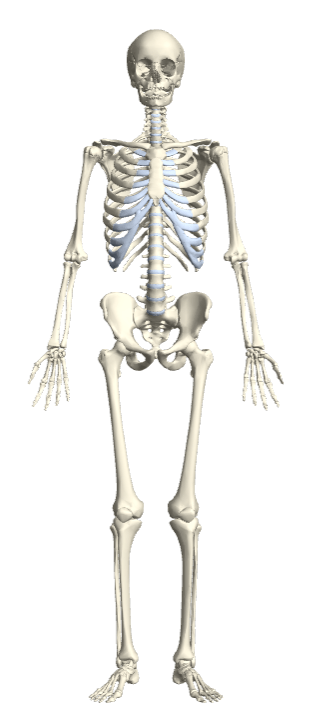
Figure 1: On left, a mesh used for upper right. It is used for flexible body analysis. On right, the mesh for the body skeleton is smoothed out for displayed purposes1.
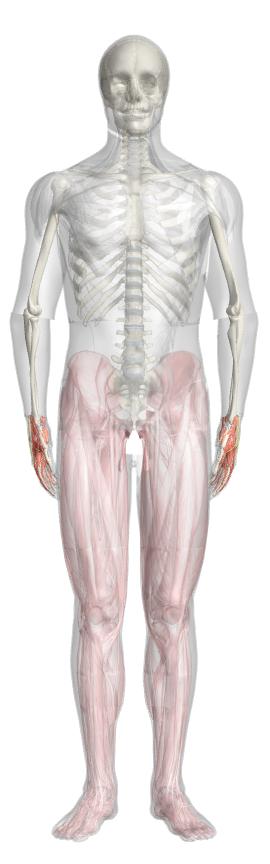
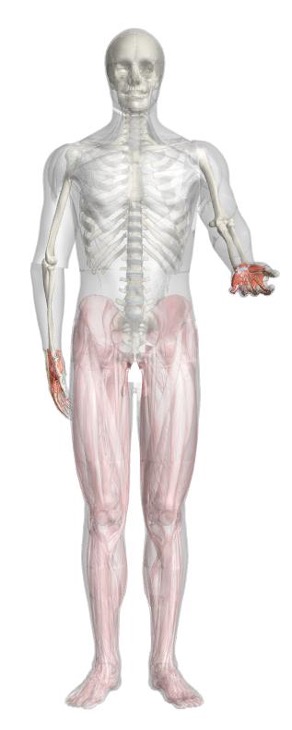
Figure 2: Comparative computer models of different types of motions found in tàijíquán can be generated to study the impact of different variations of positions
Biomechanics for Advancing Modeling
Although the modeling concepts have been developed, there is a need for appropriate biometric data to guide these models. They have been some of studies that do look at the biomechanics of Tai Chi which can aid in developing these computer models2. Praneeth Namburi has started doing some measurements that can be useful that we hope will be valuable in validating and improving the models. He is presenting a separate poster on his work.
Index: Science of Tai Chi Poster Info
References:
- These images were developed using Wolfram’s Mathematica and their AnatomyData: Wolfram Research (2015), AnatomyData, Wolfram Language function, https://reference.wolfram.com/language/ref/AnatomyData.html (updated 2016). Operations on this have been developed by this author to create these images.
- Some references of interest include:
- Ho TJ, Chou KT, Li CH, Kuo BC, Huang TC. (2018) Quantitative Motion Analysis of Tai Chi Chuan: The Upper Extremity Movement
- Nok-Yeung Law, Jing Xian Li (2022) Biomechanics analysis of seven Tai Chi movements
© 2026 James F Sturnfield

